
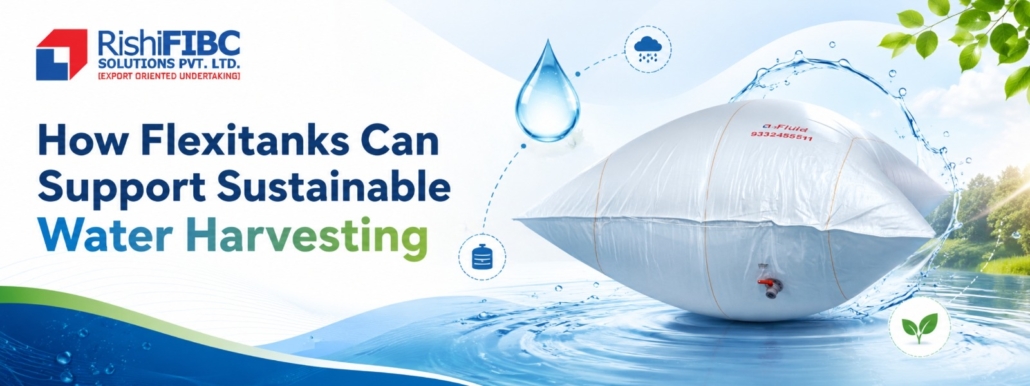
Rainwater Harvesting and the Role of Flexitanks in the Future of Sustainable Water Management
Rainwater harvesting is moving from a useful sustainability practice to a practical water security strategy. Cities face pressure on municipal supplies, industries need reliable water reserves, and farms must manage increasingly unpredictable rainfall. The challenge is no longer simply how to conserve water. It is also how to collect, temporarily store, move, and use harvested water efficiently. This is where flexible water storage systems such as a Flexitank can support a broader Water harvesting strategy.
How Rainwater Harvesting Can Benefit from Flexible Water Storage
Traditional Rainwater harvesting systems normally collect runoff from roofs or other suitable catchment areas. The water passes through gutters, filters, and first flush systems before entering a storage facility. Depending on its intended use and local requirements, additional treatment may also be necessary. The principle is simple. Capture water when it is available and preserve it for later use.
The difficulty often starts with storage. Permanent concrete or steel tanks require space, construction work, and capital investment. Fixed infrastructure can also be impractical when water is needed temporarily or at another location. It also provides another choice.
A Flexitank container can provide temporary or movable storage for various water applications; it can also be used alongside permanent rainwater tanks when mobility, temporary storage, or redistribution is needed.
Where Does a Flexitank Fit into Water Harvesting?
A flexitank is a flexible liquid containment system made using multiple layers of polymer material. In transport applications, it can be installed inside a suitable shipping container to carry large volumes of liquid. For sustainable water management, flexibility is a key benefit.
Consider a facility that collects more rainwater during monsoon periods than its permanent tank can accommodate. Rather than allowing usable water to overflow, additional storage capacity could help manage peak collection periods where technically appropriate.
There are several potential applications:
- Temporary storage: Extra harvested water can be managed when permanent capacity is insufficient.
- Water redistribution: Collected water may need to be transported from a collection point to another location for use.
- Remote operations: In the case of remote operations, sites used for construction, agricultural work, and temporary setups may still require water even if there is no permanent storage infrastructure.
- Emergency reserves: When there is a temporary requirement for extra water storage, flexible storage can be used in conjunction with the existing systems.
The exact suitability depends on water quality, intended use, tank specifications, storage duration, and applicable regulations.
How Flexitanks Can Support Water Conservation
Effective Water conservation is not only about reducing consumption. Preventing captured water from being wasted also matters.
Picture a commercial facility with an efficient water collection system but insufficient storage capacity. When there is heavy rainfall, the permanent tank fills rapidly, and when it is full, any further water is discharged. This creates a storage bottleneck.
Flexible capacity can potentially help organisations capture more of the water already available to them. It can also move water closer to where demand exists.
This makes flexible storage particularly relevant when organizations are asking how to conserve water without immediately investing in additional permanent infrastructure.
From Collection to Use: How the System Can Work
First, rainwater is collected from an appropriate catchment surface.
Second, debris and initial runoff are managed through appropriate filtration and first-flush arrangements.
Third, collected water is transferred to primary storage.
When additional capacity or transportation is required, water can then be transferred into a compatible Flexitank system. At the point of use, the water is discharged using an appropriate pumping arrangement.
The intended application remains critical. Water collected for landscaping or industrial processes has different quality requirements from water intended for drinking.
A flexitank should therefore never be treated as a water purification system. It provides containment and transportation. Water quality must be managed separately.
Potential Applications Across Industries
Flexible storage of water can support a number of different sectors. Rainwater which has been harvested can be put to use in agricultural irrigation on the condition that the quality of the water is appropriate. Industrial enterprises can gather water for the purposes of cleaning, for landscaping, for cooling, or for certain processes. Construction projects might require temporary water supplies at a number of different locations.
Remote sites can also benefit from transportable water capacity when permanent infrastructure is unavailable. For potable water applications, greater care is necessary. The complete system must use materials suitable for drinking water, and all aspects of collection, treatment, handling, storage, and local regulatory requirements must be addressed.
Why Material Quality Matters
It seems simple to store water until contamination or leakage takes place. A low-quality tank can bring the whole harvesting system into disrepute. The performance will be affected by the quality of the material, seams, and valves, puncture resistance, container preparation, and correct installation.
Fluid Flexitank uses multilayer construction designed to provide strength and flexibility for liquid containment. Selecting the correct system should always begin with the intended water application, operating conditions, required capacity, and handling method. This engineering-led approach is especially important when water must be transported rather than simply stored.
The Future Is About Smarter Water Management
No single technology will solve water scarcity. The future will require a combination of reduced consumption, efficient collection, responsible reuse, better infrastructure, and intelligent storage.
Flexible liquid containment can support that ecosystem by addressing one important question: what happens when captured water needs temporary capacity or needs to be moved?
For organizations exploring Rainwater harvesting, temporary water storage, or water transportation, Fluid Flexitank can help assess suitable flexitank solutions for the application. Speak with the Fluid Flexitank team to determine how flexible liquid containment can support your broader water management requirements.
FAQ
Flexitanks can provide additional temporary capacity when permanent tanks are full and can help redistribute collected water to suitable points of use, reducing avoidable loss of harvested water.
A Flexitank can potentially complement Rainwater harvesting by providing temporary storage or transportation capacity. Suitability depends on water quality, intended use, tank specifications, storage conditions, and applicable regulations.
Organizations can collect suitable runoff, filter it, store it responsibly, and reuse it for appropriate purposes. Flexible storage can help manage temporary excess capacity and move collected water where needed.
Potable water requires appropriately approved materials and strict hygiene controls. The complete collection, treatment, storage, and transportation system must comply with relevant drinking water requirements and local regulations.
Not necessarily. Flexitanks can complement permanent infrastructure where temporary capacity, mobility, or redistribution is needed. Long term storage requirements should be evaluated separately according to the specific project.
